Good breakers, dead rooms: what that actually means
The most common call this shop takes, and the one people most often misdiagnose as a dead panel.
September 7, 2026 · 4 min read
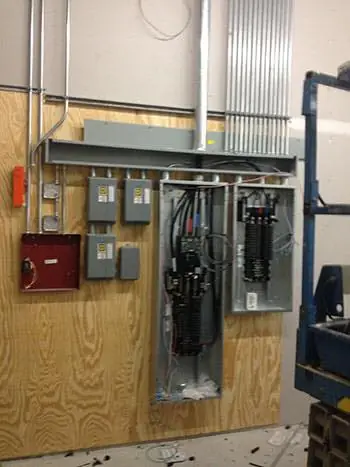
You go to the panel expecting to find a breaker sitting halfway. Nothing is tripped. Everything looks exactly as it should, and yet the back bedroom and the hallway have no power at all. It is a genuinely confusing thing to look at, and most people arrive at the same conclusion: the panel must have failed, and this is going to be expensive.
Usually it has not, and usually it is not. A breaker that is holding is a breaker doing its job. If the breaker is fine and the load is dead, the fault sits somewhere between the two, and that is a smaller problem than a failed service.
Where the break almost always is
Household circuits are not single unbroken runs from the panel to a light. They are chains. Power arrives at one device, gets passed along to the next, and so on to the end of the run. Every one of those handoffs is a connection, and connections are where electrical work fails.
The most common culprit is a backstab connection. Many outlets and switches allow the wire to be pushed into a hole in the back of the device rather than looped around a screw and tightened. It is quick to install and it holds fine for years. Then heat cycling and a little corrosion do their work, the grip loosens, and the connection starts making and breaking. Eventually it stops making altogether.
When that happens, everything downstream of it goes dark while everything upstream carries on as normal. That is exactly the pattern people describe: two or three rooms out, the rest of the house completely fine, nothing tripped.
The other things it turns out to be
- A loose or burned neutral in a junction box, which can behave far stranger than a dead circuit and sometimes shows up as lights dimming and brightening in one part of the house.
- A switch that has failed internally, which takes out everything fed through it.
- Cable damage where nobody can see it: a nail or a screw driven through a run during some earlier job, or a rodent.
- Water. On this coast that is a real answer, especially in a house that has taken water before.
- A protective device further up the chain that has done its job quietly, in a garage, a bathroom, or outside behind something.
That last one is worth checking yourself before you call anybody. If there is a test and reset button on an outlet somewhere in the house, especially in a kitchen, bathroom, garage, or on an exterior wall, press reset. One of those can feed several other ordinary-looking outlets in rooms nowhere near it, and a tripped one is invisible unless you go and look.
Why replacing outlets is the wrong move
The instinct is to buy a couple of outlets and start changing the dead ones. Sometimes it even works, because the failed connection happened to be in the first device you replaced. Far more often it does not, and now you have spent an afternoon and still have dead rooms.
The reason is that the dead outlets are the symptom, not the fault. The fault is upstream of them, in the last device that still has power. Replacing things at the dead end of the chain cannot fix a break that is behind you.
Worse, changing devices without knowing which one failed and why leaves the actual cause in the wall. A loose backstab that arced and scorched a box is a fire risk that does not stop being one because the room has power again.
How the job actually gets done
The efficient way to solve it is to work backwards. Find the last point on that circuit that still has power, then work forward to the first one that does not. The break is between those two, and it is almost always inside a box rather than in the middle of a wall.
Once it is open, the important part is looking at why it failed. A loose connection, an overloaded neutral, and a nicked conductor all read identically from the panel and all call for different repairs. Finding the cause is what stops the same rooms going dark again in a year or two.
One of Crown Electric's own customers described this exact job: three rooms had suddenly gone dead despite good breakers, and it was traced, fixed and explained rather than guessed at. That is what the call looks like from the other side.
When to stop and phone somebody
Check the reset buttons. Check the breaker really has not tripped, which sometimes means switching it fully off and back on rather than trusting how it looks. Beyond that, the honest advice is to stop.
Stop immediately, and treat it as urgent rather than annoying, if there is a burning or fishy smell near the panel or an outlet, if a cover plate or panel is warm to the touch, if you hear buzzing or crackling, or if you can see scorch marks. Those are not dead-circuit symptoms. Those are things that are still live and still heating.
Crown Electric works Monday to Friday, 7:00 AM to 5:00 PM, with emergency service available outside those hours across Beaumont, Port Arthur, Orange and the surrounding Golden Triangle. Call (409) 842-1306 and describe what you are seeing.
Crown Electric Inc — (409) 842-1306
Call (409) 842-1306More articles
How to tell your panel is out of capacity before the air conditioning tells you
The warning signs are behavioural rather than dramatic, and most of them get lived with for years.
What a standby generator actually has to be able to run
A standby generator is bought on a promise and judged on a single day, which is why the sizing conversation matters more than the badge.