How to tell your panel is out of capacity before the air conditioning tells you
The warning signs are behavioural rather than dramatic, and most of them get lived with for years.
September 7, 2026 · 3 min read
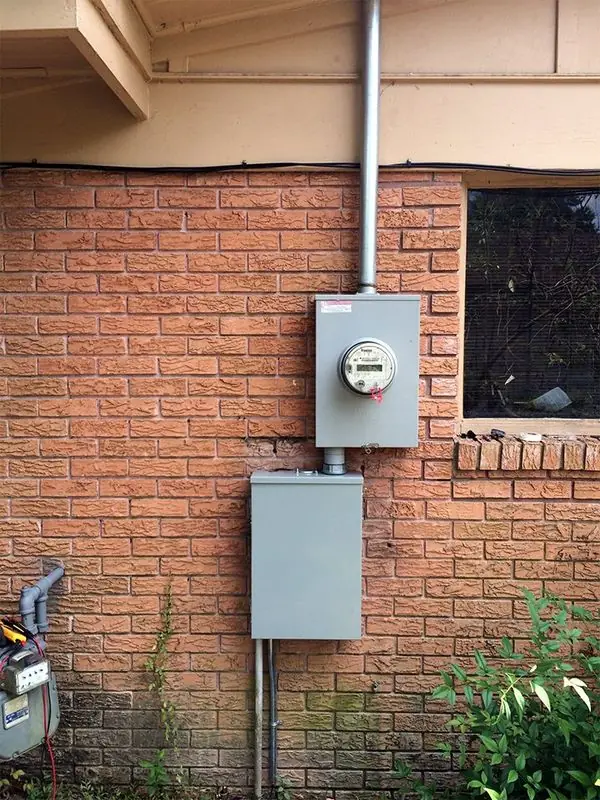
Very few electrical panels fail in an obvious way. What normally happens is that a house quietly outgrows its service, and the household adapts around it without ever quite naming the problem.
In Beaumont the thing that most often pushes a panel past its limit is cooling. A house wired decades ago was sized for the appliances of its day. Since then the air conditioning has become the single largest electrical load in the building, and on this coast it runs for most of the year rather than a few weeks of it.
The signs, in the order people usually notice them
- Lights dip briefly when the air conditioning starts. A momentary flicker on startup is common; a visible dip every single time is the service telling you something.
- A breaker trips on hot afternoons and only on hot afternoons.
- You have run out of spaces in the panel, and somewhere along the way a circuit got doubled up onto a breaker that was not designed to take two.
- Extension leads have become permanent fixtures in rooms that simply do not have enough outlets.
- The panel is a fuse box rather than breakers, or it is old enough that nobody can tell you when it went in.
- The panel or the meter base is visibly corroded, which on the Gulf Coast happens faster than people expect.
None of those is an emergency on its own. Together they describe a service that has no headroom left, and headroom is the entire point of the thing.
What a heavy-up actually is
A service upgrade, often called a heavy-up, means increasing the capacity of the electrical service coming into the building. In practice that is the service cable, the meter base, the panel and the breakers in it, sized for what the property actually draws today rather than what it drew when it was built.
It is worth being clear about what it is not. It is not a cosmetic swap of a tired-looking box for a newer one, and a shiny new panel fed by the same undersized service has not solved anything. The capacity is the job.
It is also the job that has to come first if you are adding load. A new cooling system, a workshop, a pool, a well pump or a standby generator all need the service sized for them before anything else is worth discussing.
Why this one cannot be done quietly on a Saturday
A service upgrade is different from most electrical work because it does not stop at your property. It touches the utility's equipment as well as yours, which means the power has to be dropped and reconnected by the utility on a scheduled day, and the work is permitted and inspected.
Crown Electric acquires the permit and handles that utility coordination as part of the work. This matters more than it sounds like it should: the scheduling is usually what determines how long the whole thing takes, and it is the part a homeowner has no practical way to chase on their own.
It is also the clearest reason to be wary of anyone offering to do this work without a permit or a licence. An unpermitted service change is the kind of thing that surfaces later, at the worst possible moment, when a house is being sold or an insurer starts asking questions.
The order the work happens in
The old equipment comes out. New service cable, meter base, panel and breakers go in, properly grounded and bonded. Then it is inspected, and only after that is it finished.
The small thing worth asking for, and the thing people are most grateful for afterwards, is a panel whose circuits are actually labelled. It sounds trivial until the next person needs to find the right breaker in a hurry.
How to know whether it is your turn
If two or three of the signs above describe your house, it is worth having somebody look at the panel rather than waiting for a summer where the tripping becomes constant. An assessment is a short visit and it either gives you a plan or tells you the service is fine and the problem is a single circuit.
Crown Electric has been doing this work in Beaumont since 1979 under Texas electrical contractor licence TECL #17720. Call (409) 842-1306, Monday to Friday, 7:00 AM to 5:00 PM.
Crown Electric Inc — (409) 842-1306
Call (409) 842-1306More articles
Good breakers, dead rooms: what that actually means
The most common call this shop takes, and the one people most often misdiagnose as a dead panel.
What a standby generator actually has to be able to run
A standby generator is bought on a promise and judged on a single day, which is why the sizing conversation matters more than the badge.